Driving
Through Modern Cairo, Egypt , Navigating
Cairo by Car
If you’re ever
brave enough to drive in Cairo, Egypt, you'll need to do it like schools of
fish do — fluidly, dangerously close to other cars, trucks, vans, motorcycles,
busses and Vespas; on the shoulder of the road when possible, making certain to
ignore the signals and lines that have been laid out by the Egyptian government
whenever possible. Failing to do this is to fail to be a proper Egyptian
driver, and Youssef, our driver, was a proper Egyptian who could fish with the
best of them.
He threaded his
Toyota through the mayhem of Cairo’s streets, boulevards and highways, never
stopping, because stopping is a cardinal sin. We circled immense
roundabouts, skirted scores of every kind travel conveyance known to man or
woman — scooters, tuc-tucs, leviathan tour buses, great clusters of microbuses
the size of Volkswagen vans, every one of them jammed to the teeth with humans,
so crammed that you couldn’t put a piece of paper between the people inside.
Yet they seemed as comfortable and calm as a litter of sleeping puppies.
The beeping and
honking that emits from the automobiles of Cairo never ends. It makes the horns
of Manhattan feel like a solitary walk through an English meadow. In the
Egyptian driving world beeping is not a sign of anger. It is a language, a
code. Each sound carries its own subtle meaning and all drivers understand the
lingo. There are beeps that say, “I’m here!” Beeps that mean move along, or get
out of my way, or careful, or stop or coming through. There are signals of
frustration and every so often outright anger, but that is rare. Everything is
somehow understood. I never witnessed an accident, although everything I saw on
wheels was as battered and crumbled as a tin can in an alley. Apparently when
there is an accident most people just move on unless serious damage has been
done because most drivers don’t have insurance. All of this noise, I realized,
serves the same purpose stop lights and stop signs and the lines on roads and
boulevards serve, which was why they were all ignored.
Good thing, I
thought, I was not driving. it would have been a merry game of bumper cars and
there wouldn’t have been a driver safe from the chaos. No, it was best to leave
the whole insane business in the hands of Youssef, and sure enough 30 minutes
after we departed our hotel we broke out of the city unscathed onto broad
ribbons of asphalt thereto to gape at the three Great Pyramids of Giza looking
as if they had been dropped like giant blocks against the dense, sand-colored
high-rise apartments that have erupted on the other side of the Nile. How two
things created 4600 years apart could be so physically near to one other, but
so separated by time dropped my jaw. We would visit them later, but for now, as
the broad highway took us North toward the Mediterranean, they quickly
disappeared in the rearview mirror.
Arriving in Cairo: Airports, Customs
& First Impressions
We were on our
way to Alexandria by car right now, but that hadn’t been our original plan. The
day before, we arrived at Cairo International Airport. Cyn and I rarely travel
by air, but we were forced to this time, from Athens to Cairo, because the ferry we thought we would take from Crete was
shut down by the COVID epidemic. Navigating the customs process in Cairo was
easier than expected — thanks to a man named Osama.
So in we came
the way most outsiders do, through the crowded airport to gather our bags and
bustle to customs.
The moment we
entered the customs area, we found a man, or he found us, wearing a lanyard
hung on his chest that assured us he worked for the Egyptian government. He was
all charm and cheer with a thin head of hair, mustache and perfect teeth.
“Hello!
Greetings! You have your visa?” He spoke in near perfect English.
We nodded.
“Wonderful,
then we can rush you right through customs. Right this way.”
We thanked him,
but I told him we first needed to get some cash to pay for a taxi to the hotel.
“Of course, of
course,” says the man. “You need to get to a hotel. Let me help you with that,
but here, here …” and in a heartbeat he had us at the counter exchanging money
while he stood obediently nearby. Once we had safely stowed our cash, the man
said, “Now we shall get you through customs.” He walked to the booth where
custom agents stood. We saw him nod at one of them and got in a very short
line.
“What is your
name,“ asked Cyndy. The man beamed. “Osama, as in Ben Laden,” he grinned, and
inclined his head, … “but no relation.”
While waiting
in the customs line, he asked about our plans in Egypt. We mentioned we planned
to visit Alexandria four days and then return to Cairo to board a ship up the
Nile.
“Very nice.
Very nice,” said Osama. Then he pulled out his phone and there was a rapid
discussion in Arabic. I was trying to figure out what this man’s angle was.
It’s not that I don’t trust most members of the human race, but when someone is
this nice, and you don’t personally know them, there’s usually some quid pro
quo in the cards. Yet he wasn’t asking for money or anything else for that
matter.
Osama pocketed
his phone and said with great pride. “I have arranged a car for you. It is a
perfectly reasonable price.”
What was the price I asked?
“Only $20
American.”
That was high,
I thought, but based on how far away we were and knowing we would be dealing
with the kind of traffic 18 million people generates, it wasn’t worth debating.

“Thank you,” I
said. “How do we find the car?”
Osama almost
leapt with joy. “Here is my card.” He scribbled a name on it and handed it to
me. “This is Youssef. He will be waiting for you outside and will take you to
your hotel.” Then he added, “He will also drive you to Alexandria tomorrow, if
you like. $80 American. The same cost as a train, but the ride will be so much
better.”
I wasn’t sure
of that but we hadn’t yet arranged train tickets and who knew what it would
take to find the ticketing booths at the Ramses Rail Station. I had never
been to Cairo, and suspected getting to the train depot and arranging ticketing
there would probably be bedlam … on steroids. (I had already discovered you
can’t effectively buy tickets in Egypt online). I said we’d look into it, but
secretly thought it might be a different way to travel through Egypt. We could
then take the train back from Alexandria and board the ship up the Nile in
Cairo.
Soon we cleared
customs and walked outside. Youssef appeared as if out of nowhere. It was a
warm day and we were quickly surrounded. Youssef, however, a small man with
buzz-cut hair, smoothly guided us through the crowd. He was a serious young
man. None of the bluff and good humor of Osama. Once in the car, watching
Youssef battle the traffic, it finally came to me how all of Osama’s good humor
and personalized offers of help paid off for him. Being the clever man he was,
he could never chance losing his government job by asking for cash
directly. Instead he would have minions like Youssef available. He would
shower us with kindness and help to build a relationship and then arrange to
provide a driver, a driver who could take newbies like us all over the country,
to every museum, every restaurant or city we wanted. Youssef would (I guessed)
be supplied a car, a job with tips and maybe a cut of the car payment (but
probably not). We would get our ride at a high, but not outrageous rate and
might become longer term customers. Everybody wins, but mostly Osama because he
would take the lion’s share of the payments. I couldn’t be absolutely sure this
was the deal, but if it was, it was damned clever.
Once in the
courtyard of the hotel, Youssef asked when he should pick us up for our drive
to Alexandria in the morning. Eleven AM I suggested. “Yes. I will be there!”
Cairo
to Alexandria by Car: What to Expect
Our road trip
from Cairo to Alexandria began the next morning when Youssef pulled up on time,
ready to battle the traffic once more. he was soon doing his best imitation of
schooled fish. Traveling by car in Egypt offered a very different perspective
than taking the train.
An immense
bridge swept us east across the great river and then bent us north. Once beyond
the pyramids we watched acres of high-rises, cranes and the apartment buildings
pass us by, all in various states of construction.
After nearly an
hour, we could still see the evidence of new development on the far edges of
the city. Cairo seemed to be outgrowing itself, like an adolescent outgrows its
clothes. (The population has grown 25% to 23M in just the last 10 years).
Highways here were ten lanes in each direction and often clogged. Yet Cairo was
minuscule compared to Mexico City or Tokyo. How big could the world’s
urban centers get, I wondered? How much growth could the world handle?
How much could any city? Over half the world’s 8 billion people now lived in
cities, and the trend was accelerating.
Eventually, the
thick parade of vehicles thinned as the Toyota sped us on toward Alexander’s
ancient capital. The number of buildings thinned out too. In their place
we saw resorts, some of which had not succeeded, clusters of homes and beyond
that broad orchards brimming with date and olive trees. The highway as four
lanes wide and every so often a knot of people would shoot from one side of the
freeway to the other, as if they had apparated out of the desert. Where
they came from or where they were going was unclear, but a microbus was usually
involved. At another point the Toyota zip passed an 18 wheeler that read “Love
Jesus.“ In a mostly Muslim country, didn’t expect that.
Meanwhile,
Youssef, as bereft of English as we were of Arabic, stayed to himself. In fact
he seemed unaware of our existence, treating us, whether we wanted it or not,
to his favorite (and loudest) music — Arab Rock would be the best way to put it
— while smoking one Egyptian cigarette after another. Now and again he
would assure us, “You like my driving? It’s good!!” Or sometimes, “Water?”
Otherwise we lounged in the back seat and felt the wind from our open windows
rush past like the days when I was a kid in the family car making our way to
Virginia Beach.
Exploring
Alexandria, Egypt: Food, Streets, and Local Life
By 2 pm we were
weaving our way along Alexandria’s marvelous corniche, one of the most scenic
promenades in Egypt, a great strand of road that skirts the Mediterranean,
lined with cafes, buses, and the energetic rhythm of local Egyptian culture. It
soon took us to the Steigenberger, Cecil Hotel. When I began to pay Youssef in
Egyptian pounds, he was very insistent that he not only be paid for the cost of
the trip Osama had arranged, but be tipped —Baksheesh in Arabic lingo. I hadn’t
yet developed my theory that Osama probably owned the car Youssef was driving.
I figured he owned the car, was being well paid and didn't require a tip. He
did not see it that way.
“No, no!"
He rubbed his thumb and index finger. "Tip. For airport, and here. I give
you water. I drive good! It's a big long drive." It was my ignorance I
suppose. But the way he demanded the money bothered me more than anything. His
lack of English probably didn’t help. He pushed hard and was almost panicked. I
suppose I would have been upset too if I had worked most of day, hadn’t made a
dime and had to pay for the gas. Frankly I was exasperated, but we agreed on
1000 Egyptian pounds, about $20 and then Youssef, now smiling enthusiastically
and shaking my hand, asked that we have our pictures taken together. “I will
take you back to Cairo. Take you all around Alexandria!” I passed on the photo,
and assured him that if we needed any help, we would be in touch. But we really
didn’t want to be chauffeured around either city and the plan was to take the
train back to Cairo. I never saw him again.
Alexandria
Dining Adventure: Fish, Cash, and Cultural Confusion
My tete-a-tete
with Youssef wasn't my only financial misadventure of the day. Once settled in
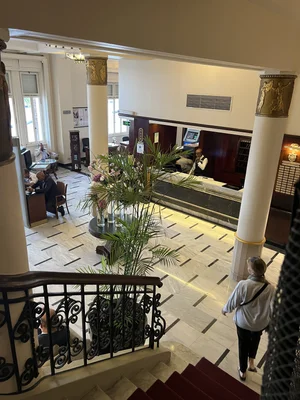
our sprawling room at the Steigenberger Cecil Hotel, grand building on the
Corniche seemingly plucked directly from the 1930s, food became a priority.
We dropped by
the front desk where Cyndy asked if anyone could suggest a good local
restaurant, a place where we could find the sort of meal one of them might like
to eat.
“Down the
corniche, to the left, perhaps a kilometer,” suggested a tall man with perfect
hair. “Very good fish. Many of our colleagues and patrons go there.”
We stepped
outside. The sunlight was golden with a warm, stiff breeze coming off the
Mediterranean as we headed down the uneven stone sidewalks that lined the inner
walk of the strand. Alexandria’s corniche rims the great sea that made so much
of the ancient world possible; a ten mile promenade of cobbled walks bounded by
beautifully crafted rock. It’s one of the world’s more arresting sites, and was
a riot of activity. Alexandria always is. Hundreds of microbuses
wended their way along the great boulevard with 16 people jammed into every one
of the bus’ four rows. Local folks called the vans micro-bassats (mee-krow bah
sat), basset meaning local, and they are used by the millions throughout Egypt.
And why not? It costs $.05-$.10 to use one, and you pay in Egyptian pounds to
the driver when you get on. They dominated the road as we navigated the
sidewalks, and climbed its big curbs, working our way through the city’s
denizens. There were no tourist here, not one we saw; only Alexandrians – men
at battered cafes, smoking strong cigarettes and sipping stronger coffee;
street kids, mostly boys, maybe eight-years-old, wearing worn shoes and
tattered jeans; women, young and old, clad almost always their hijabs, often
arm-in-arm with another woman.
We weren’t
finding many restaurants on our walk and as the sun dropped toward the sea and
were beginning to wonder if we had somehow missed the place. We were about to
turn around when we found it – Kadoura, it was called.
We walked
inside to a wall of recently living fish buried in great piles of ice that
showed off a variety of piscine delights. Four men faced us and quickly figured
out we weren't local. They explained the routine. We had our pick of sea bass,
prawn, crab, lobster, pretty much anything that could be hauled out of
the Mediterranean. All we had to do was choose the fish we wanted. We would be
charged by the kilo, about 350 Egyptian pounds each or roughly $12 a pound. We
ask the man to choose sea bass. He did and then gently directed us upstairs to
a dining area filled with local families. At the other end was a large griddle
and soon the fish was in front of us, grilled perfectly along with bowls of
brown rice, fish soup, hummus, tahini, pickled vegetables, salad, and pita
bread. It was all delicious, especially the sea bass, flash grilled, crispy on
the outside and moist on the inside. We picked it clean and scooped up all the
rest. The soup was made of crabmeat, milk and butter broth, with small clams
and shrimp thrown in. We wolfed it all down as we looked out the big window and
watched the constant passage of people below. Then it was time to pay, and that
was my second economic mishap of the day.
Egypt Travel
Tip: How I Almost Couldn't Pay for Dinner
When traveling
I keep cash in my right pocket. In cities where the exchange rate means you
have great wads of cash on hand because of the exchange rate, I keep smaller
bills on the right and the larger ones in a second left lower pocket of my
Eddie Bauer Ascent cargo pants which can be zipped shut. When I searched my
right pocket, I realized that after paying Youssef, I was short of Egyptian
pounds. Certainly not enough to pay for dinnner.
How am I going
to pay for this meal, I thought? I told Cyn the situation and then walked to
the steps below to find the very dark, handsome man, who had waited on us.
“I’m so sorry,”
I explained. “Is there an ATM nearby.”
“Of course,” he
says. “Down the street.” He pointed down the street.
Off I went into
the twilight, weaving through the crowd. In a couple of blocks I found the ATM.
Not far away a woman was sitting with her son, wailing about something she was
unhappy about and giving the boy, about nine-years-old a pretty hard time. She
hit him once and he shrunk back. I felt badly for him. I wanted to tell him,
“Come on, you can hang out with us. But what would that accomplish and he’d
think I was nuts anyhow. I couldn’t tell if the mother was simply having a bad
day or might have suffered from some mental or emotional disability. It’s a big
world, I thought, much of it is filled with pain, and I felt powerless to make
it go away. I waited for the man at the ATM in front of me. He was there for a
long time. Finally he turned and looked at me. The machine was out of order. I
tried it any way. He was right.

Now what? I
stood in the Alexandrian darkness, marinating in the beeps and crowds and the
distant sound of the Mediterranean’s pounding surf. I began to walk back to the
Kadoura wondering what I would tell the people who ran the place. I had no
solution really. Leave something behind as collateral until I returned with
payment, wash dishes, clean the toilets, haul fish (I had once done something
like this in London when I was stuck without and needed a place to sleep)? And
then a light bulb! I felt for my left lower left cargo pant pocket, the one
with the zipper. Yes!! That was where I had stashed the larger bills we had
exchange at the airport with Osama at my elbow, the back-up, “fat” cash I did
not keep handy in my right pocket. How stupid! But what relief! I could pay the
bill! And I wouldn’t have to haul fish heads out of the brine all night to pay
off the meal.
I walked back
to hotel infinitely lighter on my feet and when I strolled in I saw Cyndy
sitting on the steps, wide eyed. My God, I had walked off to work things out
with the waiter and left the restaurant without letting her know I was in
search of cash! The look on her face clearly said, “And you have been where?”
“I’m so sorry,
honey” I said, with the waiter probably wondering what the big deal was. He
didn’t know we had only been in Egypt for 24 hours and might have been hauled
away by the authorities or worse. Too many movies where the bad guys are Arab.
I paid the man
and Cyn and I sauntered back to the Cecil. She forgave me and not long
afterwards we settled into out beds. I fell asleep thinking of great fish
swimming all around me in the Mediterranean Sea with one continually coming
back to me and saying, “Where’s my money?”
FAQ
Q1: Can tourists drive from Cairo to Alexandria?
A:
Yes, although driving in Egypt — especially in Cairo — can be overwhelming for
foreign visitors. It’s often easier to arrange a private car service from Cairo
to Alexandria, sometimes right at the airport with help from a government
staffer. Drivers are usually skilled and courteous, though English is not
guaranteed. The trip takes about 2.5 to 3 hours depending on traffic.
Q2: How much does it cost to use a car service?
A:
Prices vary, but expect something comparable to Egypt’s train fares for this
route — often higher than buses, but with far more convenience. We paid $80 for
two passengers, which was fair for a private ride with door-to-door service. A
tip is expected — 20–25% is generous and appropriate.
Q3: What is the Steigenberger Cecil hotel in Alexandria
like?
A:
Built in 1929, the Steigenberger Cecil Hotel still feels like a grand, romantic
Alexandria hotel from that era. Overlooking Saad Zaghloul Square along the
vibrant Corniche, it’s hosted everyone from Winston Churchill to Al Capone.
Rooms lean toward black, white, and bronze decor. The staff is welcoming, and
the breakfast buffet is legendary — eggs, fresh pastries, hummus, baba
ghanoush, fruit, cereal, and more. Just don’t expect decaf coffee.
Q4: What can we expect from the Alexandria Corniche?
A:
The Alexandria Corniche is a sweeping waterfront promenade bounded by the
Mediterranean Sea on one side and city parks and buildings on the other. It’s
loud, energetic, and distinctly local — you won’t find many tourists here, or
many restaurants though there is no shortage of street food. What you will find
are unbeatable views of the sea and skyline, especially near the distant
Citadel of Qaitbay, built where the Lighthouse of Alexandria once stood.
Driving from Cairo to Alexandria gave us a firsthand look at Egypt’s
chaotic charm and Mediterranean beauty. Whether you're traveling by car, train,
or microbus, both cities are rich with culture, history, and unexpected
surprises.
This is
Dispatch XXXVIII in a series about a Vagabond’s Adventures - journalist and
National Geographic Explorer Chip Walter and his wife Cyndy’s effort to capture
their experience exploring all seven continents, all seven seas and 100+
countries, never traveling by jet.
If you’ve
enjoyed this dispatch, please take a look at Chip’s other adventures (and misadventures) … and don’t
forget to check the Vagabond Journal and our
Travel Recommendations to help you plan YOUR
next adventure.
Sign up here to get our newsletters delivered
to your email along with news and special offers in the Vagabond Adventure Store.
Resource: https://vagabond-adventure.com/library/cairo-to-alexandria-travel-story


0 comments:
Post a Comment